
Seeking Love in Agra
Updated: Jan 14
Since time immemorial, many a traveler has visited this heritage city of Agra. Some in search of architectural beauty, some on a detour, some to soak up the history, and some to tick a wonder off their bucket list. Well, I, on the other hand, came here on a whim, FOMO you may call it.

What’s so special about this place that makes it a must-visit tourist destination? Why does the Taj Mahal continue to captivate generations of travelers? I was here to find out for myself if the hype was worth it.

After a bumpy four-hour train from Delhi, I got down at Agra. For a city synonymous with love, you’d expect love to be in the air. But rather the air reeked with the stench of piss and fermenting trash. Such chaos is inevitable in a touristy city like this, where the monument sites are kept picture-perfect, leaving the surrounding areas in a state of neglect.
Even before I could walk out of the railway station, auto-rickshaw drivers started flocking towards me like piranhas in a feeding frenzy. Being the budget backpacker I am, I booked a motorbike taxi instead for a steal of a fare, much to their chagrin.

I navigated the historic neighbourhood of Tajganj amid the wintry November chills settling over me, finding a sharp relief from the searing heat of New Delhi.
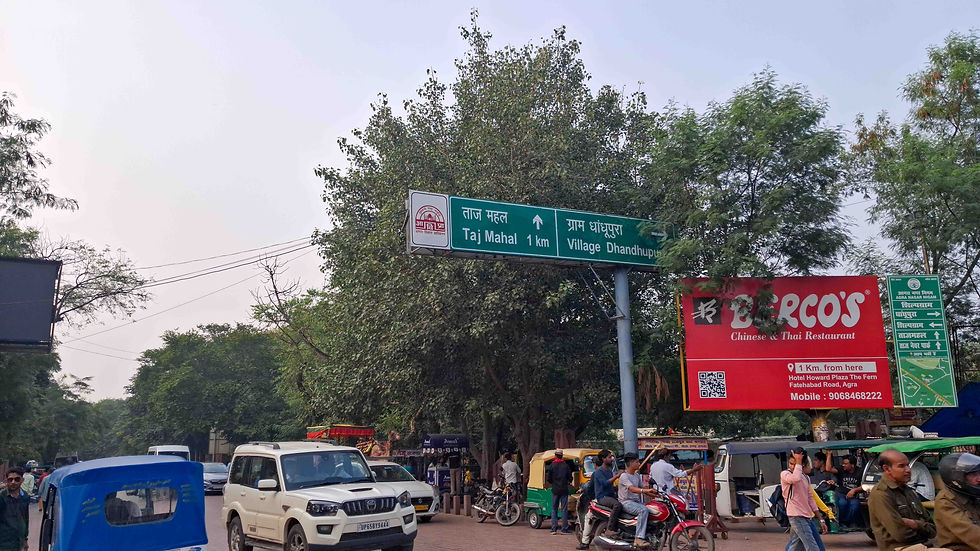
The labyrinthine streets were cramped, but I had my reasons for checking into a dorm at Joey’s Hostel, as it’s just a short walk from the famed monument.

Whatever the surroundings lacked, the rooftop made up for it with an unobstructed front-row view of the Taj. Waking up to this sight for the next three days felt like a dream.

The buzzing common area was where I chilled over board games and exchanged stories with a bunch of interesting folks, be it the Belgian backpacker who had travelled extensively at just 19, the classic Aussie who ended every sentence with ‘mate,’ or the nervous first-time traveller seeking tips for the road ahead.

The walls were alive with messages from past hostellers. I could spot a wide variety of markings like doodles, poetic verses waxing eloquent about the Taj, and shamelessly advertised Instagram handles. Heartfelt messages in foreign languages served as a reminder of just how far everyone had traveled to be here.

Not all the graffiti was pleasant though, as heated political battles over the Israel-Palestine conflict erupted across the spaces with charged slogans. The writing was on the wall in the most literal sense. The tension peaked when I passed by a mercurial Arab guy arguing with the hostel manager to whitewash a message away.

Taj Mahal
I dragged myself out of bed at six the next morning and walked to the Taj, convinced by the internet’s advice that sunrise was the best time to beat the crowds at the gates. It turned out every other person had the exact same brilliant idea, making me spend ten minutes in a queue.

Warning signs about the local monkeys were posted around the perimeter to alert the unsuspecting to the frequent mob attacks on tourists.

These tailed charlatans were jumping around from post to pillar in plain sight, possibly planning their next heist.

The vintage photographs along the passageway showed how the 17th-century monument descended into neglect after the Mughal Empire fell, remaining in decay until the British restored it to its current glory. Over the following century, the Taj Mahal captured the collective intrigue of the West and became a bucket-list landmark.
So who were the Mughals? The Mughal Empire was founded in the 16th century by Babur, a Turkic warrior from Uzbekistan who traces his lineage to Genghis Khan. They would go on to rule India for another 300 years, leaving their chequered legacy on the subcontinent.

The Darwaza-i-Rauza (Great Gate) towered as a prelude to the scale and grandeur concealed behind its red structure.

While admiring the gateway, I eavesdropped on a tour guide explaining an optical illusion to a curious family. Apparently, the Taj Mahal appears to swell in size as you walk backwards from the gate, whereas it seems to get smaller the closer you approach the entrance. This visual trick is made possible thanks to the perfect symmetry of the Taj and the precise framing of the arch.

I stepped through the gate and there it stood, lo and behold, the symbol of love Kipling so famously romanticized as “the embodiment of all things pure.”
Situated on the bank of the Yamuna River, this ivory-white marble mausoleum was commissioned in 1632 by the Mughal emperor Shah Jahan to house the tomb of his beloved wife, Mumtaz. Given the grand scale of his vision, it’s no surprise that it took 22 years and 22,000 labourers for this structure to see the light of day.

Kipling further mused, “It may be, too, that each must view the Taj for himself with his own eyes, working out his own interpretation of the sight.” Taking the celebrated wordsmith’s lead, here I was forming my own perspective. And to be honest, I felt remarkably nothing. Despite the romantic mystique associated with this place, my visit lived up to neither its hype nor the grandiloquent descriptions it had inspired.

Perhaps the overt commodification by the tourism industry made the monument feel like yet another checked box on a list rather than a sublime experience. Nevertheless, I was lost in cynical contemplation as the sun kissed the white marble domes in the early morning hours.

Well, I was not the only one lost in profound thought though. A furry primate kept me company as we both gazed at the calming waters of the river.

Exalted for its minute details, the Taj is considered the definitive example of Indo-Islamic architecture. Up close, I could see the grand facade adorned with Islamic calligraphy, designed using the Italian technique of pietra dura where semi-precious stones were cut with precision and fitted into the white marble.

Crossing the threshold into the interior, one would naturally anticipate a sight that mirrors the magnificence of the façade. Au contraire, most of us found ourselves staring at two nondescript graves. A classic case of the gift wrap being far more interesting than the actual gift within. It’s a mausoleum, so what else should we expect? Well, some things are only ever meant to be viewed from a distance.

Mumtaz Mahal rested alongside her dear husband. Her name, which translates to ‘beloved ornament of the palace’, is befitting for a woman regarded as the epitome of femininity during her time, so much so that the then poets would sing praises of her beauty and gracefulness.

Across the river lies the supposed site of the Black Taj, the mausoleum that Shah Jahan intended to build for his own burial, but fate had other plans when his son Aurangzeb overthrew and later imprisoned him.

Insta-happy tourists were clicking pics in their own world, not to mention the mandatory tourist pose where their fingers appear to hold the dome by its tip. Is this some sort of rite of passage for unimaginative tourists visiting iconic structures? Since the authorities have already banned snacks and power banks inside the premises, I can only wish they would ban this cringefest too someday.

The sweet spot is the centre of the reflective pool, where one gets the perfect symmetrical snap. I watched as some tourists had the audacity to take their own sweet time and shoo others away from their frame, behaving with a sense of entitlement as if they were the direct descendants of Shah Jahan himself. And then came the hordes of overzealous Europeans posing in Indian ethnic wear to live out their Bollywood fantasies. Cultural appropriation, much?

The Taj welcomes visitors throughout the week save for Fridays, when entry is reserved for local Muslims to offer prayers in the red sandstone mosque facing the Kaaba in Mecca.

The Mughal heritage of Agra is reflected in its considerable Muslim population today. During a ride with a local Muslim youth on a bike taxi, the conversation turned to the political realities of the region and the hardships his people face under a state government motivated by Hindu majoritarian interests.

Clingy vendors called out “Hello, my friend” as I made my way out, pestering me to visit their tourist trap souvenir shops. Miniature replicas of the Taj were sold at exorbitant prices, and the vendors slyly claimed the trinkets were carved from the same white Makrana marble as the monument itself. They touted these as the perfect token of love for a girlfriend, a pitch that was wasted on me since I don’t actually have one.The irony was not lost, for there is something peculiar about how a mausoleum was rebranded as the symbol of living love. That’s an important lesson in marketing right there.

Others were shouting to anyone walking past, asking them to buy their “world famous Agra Petha.” Aside from the Taj Mahal, this confection serves as the other defining trademark of the city, and no one is bound to leave Agra without trying this. Given the number of shops selling it, that was a hard pass from me. Past experiences had taught me not to buy anything in such touristy areas, as they are often prone to inferior quality and inflated prices.

While checking out places to eat at Tajganj, I zeroed in on a restaurant specializing in Mughlai cuisine. With soft lighting and elegant decor, the place did justice to its name, The Nawaabs, which refers to a royal title bestowed by the Mughal emperor upon Muslim rulers.

The order was a no-brainer: Chicken Tikka Biriyani. Possibly derived from a Persian rice dish, biriyani consists of marinated meat slow cooked with layered rice that was originally created in the royal Mughal court kitchens. I devoured the flavoursome morsels blended with the tender meat chunks, accompanied by raita, a side of yoghurt mixed with fresh mint leaves.

St. George’s Cathedral
The next morning being Sunday, I headed to St. George’s Cathedral to attend the worship service. The serene cantonment area was a peaceful world away from the cacophonous tourist circuit of the city.

The Anglican cathedral was built in 1828 as a garrison church for British soldiers stationed in the cantonment.

Being the first to arrive, I was greeted by Reverend Mark J. Walsh, a priest of Anglo-Indian heritage who seemed surprised by a newcomer’s presence. He mentioned how rare it was to see a young traveller attending a church service instead of the usual Sunday sightseeing.

As we spoke of the Gospel, an epiphany dawned on me. For long, the Taj Mahal has been glorified as the ultimate symbol of love because a king built a grand landmark for his dear wife. The true symbol of love, though, is not a tomb but the cross. The King of Kings came in flesh and blood to give his life for all mankind. That’s the only true symbol of love, beside which everything else stands defeated and simply cannot be compared.

The traditional Anglican hymns of yore and the impassioned sermon by Reverend Walsh in God’s presence uplifted the morning mood.

Once the service ended, I sought his prayer and he prayed for me. He warmly invited me for high tea and introduced me to the congregation members. We exchanged digits before I took my leave, grateful to have made a genuine connection during my travels.

Sadar Bazar near the church was the prime shopping district of Agra. Shoes, confections, handicrafts, clothes, the list of what you could get here was endless

The narrow lanes of the bazar were lined with food stalls offering a wide platter of local dishes.

Panchhi Petha, a reputed confectioner brand, has been traditionally making pethas for a century now. I was directed to this outlet in Sadar Bazar by locals when I checked with them on where to find the authentic version.

This signature confection is prepared from fresh ash gourd that is cured and simmered in sugar syrup to create a soft, translucent candy. Local lore has it that Shah Jahan tasked his royal kitchen with creating a treat as pure and white as the Taj Mahal itself, giving rise to the petha we know today.

Boxes of pethas were stacked on the shelves, ready to be taken home by travellers as the quintessential sweet souvenir of their trip.

There were so many flavours to choose from, yet so little in my budget, so I settled on the mixed assortment featuring a rainbow of pethas. From rose and saffron to paan and the OG white, I relished these treats as they dissolved in my mouth, and I finally understood why it takes three days to create the perfect petha.

After the sugar, came the spice. I picked up a packet of Agra dalmoth, a tangy snack made from gram flour and dry fruits, to nibble on the journey back.

Agra Fort
The Taj often overshadows the many monuments that call Agra their home, even though these heritage landmarks are significant in their own right. Prime among them is the Agra Fort dating back to the 16th century. This red sandstone fortress was the royal residence for the Mughal Empire during its formative years before the capital shifted to Delhi.

The fort used to be surrounded by two moats, a wet one where hungry crocodiles awaited their prey and a dry one with starving tigers. Invading armies had to cross this challenge to capture the fort. Now I know why this fort had been impregnable.

Inside the fort is the Jahangiri Mahal, the palace reserved exclusively for the royal wives of the Mughal dynasty. This was commissioned by Mughal Emperor Akbar, the grandfather of Shah Jahan.

The Hauz-i-Jahangiri is a giant bathtub carved from a single massive block of stone, which was once filled with fragrant rosewater preferred by the royals.

Akbar’s son Jahangir is famously remembered for installing the legendary Chain of Justice at the fort, an eighty-foot golden chain that stretched from the palace to the banks of the Yamuna River and featured sixty bells at its end. Any commoner in the kingdom seeking justice could pull the chain to gain the emperor’s attention.

While Shah Jahan conducted public hearings for his subjects in the Diwan-i-Am, the Diwan-i-Khas was reserved for receiving guests of higher stature like royals and foreign diplomats.

This class divide between the plebs and the nobles was reflected in how the latter was physically elevated above the former.

High atop the fort sits the Musamman Burj, an octagonal tower that Shah Jahan built as a palace for Mumtaz Mahal. Being the aesthete he was, he designed the structure to feature precious stones embedded into the white marble.

The Sheesh Mahal, or Palace of Mirrors, is adorned with thousands of tiny glass fragments inlaid across the walls and ceilings. The genius behind this design is that all it takes to light up the entire space is a single lamp, as the mirrored surfaces would multiply the light into an infinite glow.

Overlooking the river, this tower offers a vantage point to take in panoramic views of the Taj Mahal.

Eventually, Shah Jahan was overthrown by his son Aurangzeb, who usurped the throne after declaring his father incompetent. The fallen emperor was placed under house arrest and spent the last eight years of his life locked up in this tower, where he would sadly gaze at the masterpiece he commissioned.

History will tell you that Aurangzeb was the most infamous Mughal emperor in the lineage, owing to his reputation as a cold, ruthless tyrant. The walls of this fort have witnessed enough family drama to rival any Shakespearean tragedy.

Tomb of Akbar
If Aurangzeb is remembered as the most despised Mughal, his great grandfather Akbar is on the opposite end of the spectrum. His tomb in Sikandra is about sixteen kilometres from Tajganj. As there was a lack of public transport connectivity to the site, I hopped onto a bike taxi and went on a long ride to reach there.

Akbar commissioned this tomb during his lifetime. Witnessing such exquisite artwork makes it obvious where Shah Jahan inherited his genes for architectural excellence.

What surprised me was finding almost no one around at the tomb of Akbar (not counting the local couples seeking a moment of privacy away from the judgmental eyes of Indian society). While people continue flocking to the Taj Mahal in large numbers, Sikandra remains a ‘maybe’ in most Agra itineraries. It seemed the incoming tourists had overlooked the legacy of the great Mughal.

Artistic symmetry is ubiquitous no matter where you go in Agra, and the interior of this tomb was no exception.

The entry gate led to a ramp that descended to the floor below. The temperature dropped noticeably as I moved through the passage and into a cavernous chamber where Akbar was laid to rest.

At the time of his reign, the emperor was considered a political mastermind and an icon of religious pluralism. He enacted social reforms that were revolutionary back then, such as abolishing the jizya tax on non-Muslim subjects and legalizing widow remarriage. His actions earned him the title Akbar the Great.

A ten-minute walk brought me to the tomb of a woman who made her mark on Mughal history. Mariam was to Akbar what Mumtaz was to Shah Jahan.
Born a Hindu princess and wed as part of a strategic political alliance with a Rajput king, she became the favourite wife of Akbar and went on to bear his successor, Jahangir.

Even after her marriage, she didn’t convert to Islam and influenced his policies which advocated for religious tolerance. In an era when women were often hidden from the public sphere, she was as a skilled entrepreneur who commissioned ships to carry pilgrims to Mecca and managed a trade network of silk and spices that extended to the Middle East. Talk about being multifaceted!

Renowned for her ethereal beauty and graceful intellect, she was given the title Mariam in honour of Mother Mary, whom Muslims hold to be the greatest woman to have ever lived.
Her desire to stay close to her husband persisted even after her death, as manifested by the short distance between their tombs.

Guru Ka Taal
A security guard outside the tomb suggested that I visit the nearby gurudwara (a Sikh place of worship) so I got onto a shared auto rickshaw heading in that direction. Guru Ka Tal is a legendary Sikh pilgrimage site dedicated to the memory of Guru Tegh Bahadur, the ninth Guru (Sikh prophet).

Guru Tegh Bahadur was ordained in 1664 at a time of religious upheaval when Aurangzeb undid the religious pluralistic policies of his ancestors and enforced strict Islamic orthodoxy. This dark era was defined by forced conversions and the reintroduction of the jizya tax, inflaming social unrest. When a group of Hindus from Kashmir sought protection, the Guru shielded them and challenged the hardline emperor to convert him first.

The fearless Guru offered himself voluntarily to Aurangzeb at this very place, where he was arrested. Upon his arrest along with five of his loyal followers, he was given the choice to convert to Islam or face a death sentence. Nevertheless, the Guru remained unyielding and was executed, thus martyring himself for the sake of religious freedom.

His martyrdom was a watershed moment for the collective consciousness of the Sikhs. His son, Guru Gobind Singh, who succeeded him as the tenth and final Guru, founded the Khalsa, a brotherhood of Sikhs who publicly take a vow to follow a certain discipline.

Maninder Singh, an entrepreneur selling dairy products on the premises, shared the tenets that Sikhs like him are sworn to uphold, such as the wearing of a turban, abstinence from alcohol and tobacco, and a commitment to fidelity, to name a few.

The sun was out and bright, making me grab a bottle of Badam Doodh, a chilled beverage where fresh creamy milk is blended with crushed almonds. It was just what I needed to refresh for the rest of the journey.

My next stop was St. Peter’s College, one of the oldest convent schools in India. Beyond their spiritual duties, Christian missionaries pioneered modern education in the region and founded institutions that have educated generations.

The Cathedral of the Immaculate Conception was established in 1848 and is the seat of the Archbishop of Agra. Designed by Italian architects, its grand Neo-Gothic structure is a testament to the heritage of the city’s Catholic community.

Since the college gates are open to outside visitors only on Sundays, I seized the opportunity to enter by quietly joining the congregation gathered for holy mass.

Akbar’s Church
In 1580, Akbar invited a group of Jesuit priests from Goa to his court. Greatly impressed by their teachings, the emperor generously granted them land and even funded the construction of a church. Named Akbar’s Church in honour of him, the house of prayer was completed in 1598 and became the first Catholic church in Northern India. According to missionary accounts, Akbar was occasionally seen praying here in reverence, removing his turban and kneeling upon the ground in devotion to this sacred space.

An old pirate proverb says that dead men tell no tales, but the tombs at the Roman Catholic Cemetery a couple of streets away seemed to whisper otherwise. This historic burial ground was originally founded in 1550 when Emperor Akbar granted land for the city’s growing Armenian Christian community to bury their dead. Over the centuries, it became the final resting place for Christians from France, the Netherlands, Italy, and England.

At first glance, I wanted to check if it was indeed the right location on Google Maps since the place was filled with what looked like a series of Islamic tombs.

Had I missed spotting the crosses on top, I’d have easily mistaken these structures for Mughal maouselums given their chatris (pillared domes) and Arabic script engravings.

Red Taj
The central attraction is the Tomb of John Hessing, nicknamed the Red Taj Mahal. The word ‘hidden gem’ has been abused by travel influencers to label anything and everything, but this is a legit spot that genuinely deserves the title. Much like the grand structure it is modeled after, the origin of this place is an ode to love, only with the genders switched in this story.

A Dutchman who earned great repute as a brave soldier, John Hessing rose through the ranks to become the commandant of the troops at the Agra Fort. When he died in battle defending the fort against the British in 1803, his widow Anne spent a fortune to build this red sandstone mausoleum as a tribute to her loving husband.

Although the original design was supposed to be identical to the Taj Mahal replete with four grand minarets, the structure was never completed since Anne exhausted her money and was forced to compromise on her vision.

The adjacent tomb of Walter Reinhardt was ivory white in contrast to that of Hessing. The French mercenary’s life story has all the elements needed for a swashbuckler flick.

Known as Le Sombre (dark one) due to his tanned complexion, he fished in troubled waters by freelancing as a warlord for local rulers and amassing a great fortune from regional conflicts. This gun-for-hire was infamous for often switching allegiances for the sake of financial gain. Such was the fear he instilled among the British that they placed a hefty bounty on his head.

Travelling in today’s world is so effortless, but imagine the challenges of doing it four centuries ago. John Mildenhall was an adventurous explorer who became the first to travel from England to India by land, where he was granted a personal audience with Emperor Akbar. He became the first Englishman to be buried in the subcontinent.

Marty’s Chapel is the oldest structure in this cemetery. It takes its name from Khoja Mortinepus, an affluent Armenian merchant who was buried here in 1611. A devout follower of Christ, he was revered for his righteousness and charity.

Besides Mortinepus, a number of Jesuit and Armenian priests whom Emperor Akbar befriended in his quest for knowledge are buried here. Today the tomb doubles up as a chapel, welcoming visitors with a small altar filled with the scent of sacred incense and marigold flowers.

Armenian settlers first arrived in Agra during the 16th century to trade in silks and precious stones. They won the heart of Emperor Akbar, under whom they built a settlement and flourished. The first church ever in the city was an Armenian Orthodox church founded in 1562, though it no longer exists. Not only did Akbar finance the construction of this church, but he also took an Armenian woman as one of his wives. Armenians enjoyed an elevated status in his inner circle, from his chief justice Abdul Hai to his harem’s royal physician Juliana to his courtier Mirza Zul-Qarnain, who forged diplomacy between the Mughal Empire and the Portuguese.

Over a span of three hundred years, more than one hundred Armenians were laid to rest within these hallowed grounds. Etched in classical Armenian, the epitaphs upon their gravestones are the sole remnants of a once-thriving community that made Agra their home.

Baby Taj
Millions of tourists flock to the Taj Mahal every year, yet only a small fraction ever discover the Baby Taj. When my hostel manager first recommended the site, the cute name made me chuckle.

Paradoxically, the monument bearing this moniker predates the Taj Mahal by 25 years.

The Tomb of Itimad-ud-Daulah is the inspiration behind the Taj Mahal. This breathtaking white marble mausoleum deserves to be appreciated in its own right, sans being cast under the shadow of its more famous successor.

Intricate geometric tile work and painted floral motifs graced the inner walls in an exquisite display of Mughal artistry.

Mirza Ghiyas Beg was a Persian noble who migrated to India and joined the royal court during the pinnacle of Akbar’s reign when trade and culture flourished. He was subsequently conferred the honorary title Itimad-ud-Daulah (Pillar of the State). What’s interesting is that he was the grandfather of Mumtaz Mahal. Connect the dots and you’ll know where Shah Jahan sought inspiration to build his own iconic mausoleum.

Dinnertime brought me to Aleem. This humble diner, which had just a few tables squeezed together, is popular among the locals for serving delicious Mughlai food that’s easy on the wallet.


The smoky aroma of kebabs rising from the chargrill assaulted my senses the moment I walked in.

It took a good amount of time for my order to arrive, which is good because it’s proof that means they are cooking it fresh and not reheating pre-cooked dishes unlike many restaurants today. On my plate was a Mughlai Paratha, a crispy flatbread baked in a clay oven, and Mutton Mughlai, a slow-cooked lamb curry with tomatoes, garlic, whole spices, and yogurt. The combination was just too good for my tastebuds.

A kebabholic like me couldn’t leave without trying the meat skewers. The Chicken Sheek Kebab, which came doused generously in dahi gravy (spiced yoghurt), was chef’s kiss.

I stumbled upon Haji Salim Sweet House during my post-meal stroll across the street. I’m not much of a dessert person, yet I couldn’t resist a serving after watching the live preparation of halwa, a sweet, gooey paste made using flour, milk, and dry fruits.

This confection of Persian origin spread widely across the Indian subcontinent during the Mughal conquests. The Chuhara Halwa I got was prepared with dried black dates and cashews simmered in thickened milk.

Fatehpur Sikri
Since I had already covered most of the sites in Agra, I decided to dedicate an entire day to exploring Fatehpur Sikri. I boarded a bus the next morning from Idgah Bus Station, and reached the historic site a good hour later.
Fatehpur Sikri, the City of Victory, was founded by Emperor Akbar in 1571 as the capital of the Mughal Empire. The meticulously planned red sandstone city heralded the golden age of the empire. This is among the three UNESCO World Heritage Sites in Agra, the other two being the Taj Mahal and the Agra Fort.

The Buland Darwaza (Door of Victory) welcomed me to the city. Built by Akbar to celebrate a military triumph, it’s the highest gateway in the world. The Persian inscription on the arch reads, “Jesus, Son of Mary (on whom be peace) said: The World is a Bridge, pass over it, but build no houses upon it. He who hopes for a day, may hope for eternity; but the World endures but an hour. Spend it in prayer, for the rest is unseen.”

There is something deeply poetic about the fact that the grandest gate in the world bears the words from the one who identified Himself as a gate when He said in John 10:7, “I am the gate; whoever enters through me will be saved.”

The Jama Masjid is a Sufi mosque which was the largest mosque in the empire at the time of its construction. Sufism is a mystic tradition in Islam that places emphasis on purification, spirituality, and asceticism. Akbar became increasingly influenced by Sufi teaching, which shaped his worldview of Sulah-i-Kul, or universal peace.

Saddened by the lack of an heir apparent, Akbar visited Salim Chishti, a Sufi saint who lived in a cavern in Sikri to seek his intercession for a male heir. The ascetic blessed the emperor, and a son was born to Akbar and Queen Mariam a year later. Out of gratitude, the emperor named the boy Salim after the saint, and this young prince would later take the throne as Jahangir. When the holy man saint met his maker, Akbar commissioned this marble mausoleum, which stands at the centre of the mosque quadrangle.

I removed my shoes and entered the tomb barefoot with my head covered as a mark of respect. Centuries after his passing, couples still travel from distant lands to this sacred site to seek the blessings of the saint to bear the gift of having children. I looked around to notice many offering a chaddar, a fragrant sheet made of fresh roses, and tying a crimson thread known as a kalava to the marble jali (lattice window) of the tomb.

Singers in the quadrangle rendered soulful qawwalis, Sufi devotional songs intended to bring one closer to God.

The Jodha Bai Mahal is the the largest palace in Fatehpur Sikri, dedicated to Akbar’s favourite queen Mariam-uz-Zamani. Akbar was mindful of the fact that she was a Hindu princess, and he took extra care in ensuring that her new home’s design featured elements of Hindu architecture.

Had I come here four hundred and fifty years ago, I would not have been allowed to enter. This area was the zenana, exclusively reserved for the royal women and their female attendants.

The Panch Mahal is perhaps the best kept secret inside Fatehpur Sikri. This five-story palace is where Akbar would perform the Jharokha Darshan, the daily ritual where he addressed the public waiting in the courtyard below.

Walking through the red stone structures of Fatehpur Sikri brought back fond memories of reading The Enchantress of Florence by Salman Rushdie. The story begins with a stranger arriving to meet Akbar at his court in this very capital.

Speaking of stories, the folk tales of Akbar and Birbal are the cherished legends of the Mughal era. Celebrated for his wit, he lived in this palace and was part of the navaratnas, the nine jewels of the court, where each minister was an expert in a specific field of science, literature, or the arts. One such tale tells of the time Akbar challenged his ministers by drawing a line and asking them to make it shorter without touching it. While the others were racking their brains, Birbal simply drew a longer line next to the one drawn by the emperor, leaving everyone astonished.

At the far end of the city is the Naubat Khana, the gate where drummers were once stationed at the top to announce the arrival of the emperor to the capital.

I was so into exploring the nooks and crannies of the capital that I lost count of time. By the time I checked, I realized I spent over four hours wandering through the site.

Travelling to Fatehpur Sikri was a last-minute decision I made, and I am so glad I got to discover it at my own pace.


While stepping outside Fatehpur Sikri to catch my bus, my path was blocked by a baraat, a celebratory wedding parade that escorts the groom to the venue. The sound of trumpets resounded as the man of the hour rode a white horse through the centre of the crowd, dressed like a traditional prince. In this part of the world, you don’t just get married with a small group of friends, you announce it to the whole city.

The morning of my last day in Agra began with a visit to the happening Deviram Sweets to get a taste of bedai sabzi, the much loved breakfast of the locals.

Weaseling my way through the hungry crowd, I spotted the cook frying fluffy pooris in a giant pan until they reached a crunchy texture. He kept bringing basketfuls of bedai, and they vanished in minutes.

The vendor ladled the sabzi, a spiced gravy of potatoes, into a leaf bowl of pooris and kachoris before topping it with a dollop of dahi.

Dipping the piping hot poori into the spicy sabzi offered comfort on that chilly morning. There are loads of hyped food places on the internet that fail to live up to the social media sizzle, but this place is the real deal.

The eatery is called Deviram Sweets for a reason, so I made sure to grab a mouthwatering jalebi before jetting off. I had barely ten minutes to reach the nearby stand and catch my bus to the next destination.

Agra is a city where minarets and metro trains exist side by side. Once the epicenter of one of the largest empires in Asia, it has been witness to the rise and fall of grand ambitions. The four days I spent here, I went beyond the usual tourist trail and winged my way through. You get your heart stolen not by a single monument but by the hundred little stories hidden in its dusty corners. Perhaps that’s the real reason they call it a city of love.

Well done for all this detail, such an interesting trip:)
Such a lovely read! Baby Taj is something new I learned today.
Lovely 🥰 Did not realise there was so much in Agra 🤩
great travel blog. feels like your style got a bit edgier - i like. keep going!